Craig McDermott
American PsychoCraig McDermott is a Wall Street associate who appears within Patrick Bateman’s tightly controlled social world of offices, bars, restaurants, clothes, and status competition. He is not presented through a private history or an independent inner life; instead, his character is built through repeated public performances. He knows the right people, reaches the right tables, asks the right questions about clothing and etiquette, and moves easily among men whose identities are continually confused with one another. His significance lies in that social fluency: McDermott helps make visible the culture of conformity and display that allows Bateman’s violence to remain submerged beneath ordinary professional sociability.
Identity and Social Setting
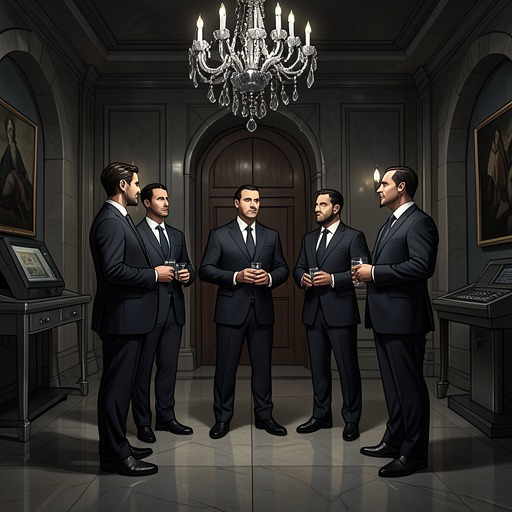
McDermott belongs to the same affluent financial milieu as Bateman, Timothy Price, David Van Patten, and the other young men who circulate between Wall Street offices and fashionable Manhattan venues. At Harry's, he is seated with Van Patten while the two write on the backs of paper napkins, with a Scotch and a martini in front of them. Their conversation is not about substantive financial work but about how a business suit should be worn, a detail that places McDermott inside a world where tiny distinctions in dress carry the weight of personal identity.
His appearance is described with the same exacting attention that governs the men’s conversations. At one meeting, he wears a woven-linen suit with pleated trousers, a button-down cotton-and-linen shirt by Basile, a silk tie by Joseph Abboud, and ostrich loafers from Susan Bennis Warren Edwards. At another, he arrives in a houndstooth-check suit, a striped dress shirt, a paisley silk tie, and new redwood-framed Oliver Peoples glasses. The clothing does not merely decorate him; it is his public credential. McDermott’s self-presentation depends on being legible as prosperous, informed, and properly placed within the group.
Social Performance and Expertise
McDermott’s most recognizable trait is his anxious investment in rules of appearance. At Harry's, he asks Bateman whether tasseled loafers are appropriate with a business suit, adding that Bateman should not look at him as if the question were insane. The question is comic because it is trivial, but it is also serious within the group’s social economy. McDermott seeks confirmation that his appearance will communicate the correct identity to the correct audience.
His authority is not limited to clothing. At Pastels, McDermott knows the maître d', and that personal connection produces an immediate table even though the group made its reservation from a cab only minutes earlier. The party is impressed, and possibly envious, because securing a table at Pastels is understood as evidence of access and competence. McDermott’s social capital therefore becomes practical power: he can convert familiarity with a gatekeeper into a coveted place in the restaurant’s brightly lit dining room.
The same pattern recurs in the Friday gathering at Harry's, where McDermott participates in a debate over possible dinner destinations including Flamingo East, Oyster Bar, 220, Counterlife, Michael's, SpagoEast, and Le Cirque. Questions are routinely directed toward Bateman about pocket squares, shoes, compact discs, tie knots, and clothing care, but McDermott remains part of the collective tribunal that treats taste as a form of expertise. The group’s conversation turns everyday choices into tests of belonging, and McDermott is both an examiner and a candidate within that system.
Relationships and Group Function
McDermott’s relationship with Bateman is marked by familiarity, rivalry, and the casual aggression of male group culture. He addresses Bateman directly, expects him to possess authoritative opinions, and includes him in the joking and competitive atmosphere surrounding clothes, women, restaurants, and professional status. At Pastels, McDermott’s successful intervention with the maître d' gives him a moment of superiority over the others, while Bateman’s later display of his new business card similarly seeks recognition from the table. Their interaction is thus less an intimate friendship than a continuous exchange of status claims.
McDermott also participates in the group’s treatment of people outside its protected circle. When the men arrive at Pastels, Timothy Price throws a napkin bearing Van Patten’s carefully phrased question for GQ at a homeless man holding a cardboard sign that reads I AM HUNGRY AND HOMELESS PLEASE HELP ME. McDermott is part of the social environment in which such an act can occur without interrupting the evening’s momentum. The episode places the group’s polished concern with etiquette beside its disregard for hunger, exposing the narrowness of the standards by which McDermott and his companions judge conduct.
At another gathering, McDermott appears alongside Price, Preston Goodrich, Robert Farrell, and the man who may be Todd Lauder. The group discusses dinner reservations while Farrell monitors commodities on a portable stock-quotation device and everyone’s clothing is itemized by designer and fabric. McDermott’s participation confirms that his identity is collective: he is one of the men who sustain the setting’s codes, repeat its questions, and help transform ordinary social contact into a competitive display of cultural and economic capital.
Narrative Contrast and Thematic Significance
McDermott’s scenes are important because they establish the social surface against which Bateman’s private impulses become almost impossible to distinguish from ordinary behavior. The men talk about reservations, martinis, ties, pocket squares, and business cards with intense seriousness, while cruelty toward homeless people and fantasies of violence appear within the same conversational world. McDermott is not shown as the source of Bateman’s homicidal desires, but his presence helps define the environment that normalizes emotional vacancy and turns human beings into categories, impressions, or status objects.
The narrative repeatedly surrounds McDermott with problems of mistaken identity. In the traffic outside the cab, a man who resembles Luis Carruthers is mistaken for someone else and then returns to reading USA Today. Inside the financial and social circles, clothing, grooming, and manners produce interchangeable figures whose individuality is difficult to sustain. McDermott’s carefully specified suits and accessories make him recognizable as a type while also making him resemble the others. His apparent individuality is therefore paradoxical: he stands out through exact conformity to the group’s standards.
McDermott’s success at Pastels and his repeated participation in questions of taste give him symbolic power, but that power remains superficial. It depends on the continued acceptance of the codes he performs and on the audience’s willingness to treat access, clothing, and etiquette as meaningful distinctions. Bateman’s world eventually reaches a point at which even confessions of murder can disappear into mistaken names, absent witnesses, and social indifference. McDermott’s role in that world is not to solve or expose its violence, but to help make its polished surface convincing enough that violence can pass through it unnoticed.